Media
Contact
Communications Specialist
Faculty of Engineering
Spencer Engineering Building
Room 2072
Western University
Tel: 519-661-2111 ext. 87015
Email: engineeringcomms@uwo.ca
Two Western graduate students named 2026 IBET Momentum Fellows
Afonso Moniz and Isabel Higgon are Western's newest Indigenous and Black Engineering and Technology (IBET) Momentum Fellows.
The IBET Momentum Fellowship, created in partnership with several universities across Ontario, supports and increases the representation of Indigenous (First Nations, Inuit and Métis) and Black PhD students in STEM programs. Fellowship recipients receive financial support, mentorship, training and networking opportunities to foster a robust professional community.
Afonso Moniz
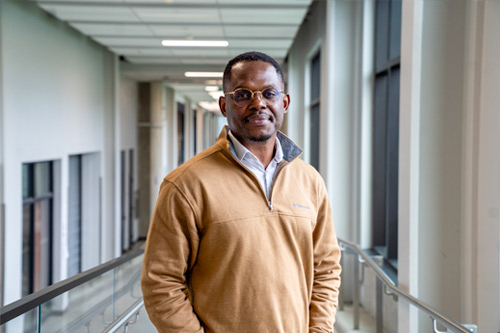 “This award gives me the opportunity to advance my research while easing financial and social pressures, allowing me to focus fully on my academic goals,” said Moniz, a PhD candidate in the department of electrical and computer engineering, specializing in power systems.
An engineering career spanning two continents
Moniz brings more than 15 years of engineering and technical experience in the electrical and telecommunications industries, both internationally and in Canada, to his doctoral work. He earned a bachelor's degree in power systems engineering from Agostinho Neto University in Luanda, Angola, in 2012 and an MEng in electrical and computer engineering from the University of Ottawa in 2024. He is now pursuing a PhD in power systems engineering at Western, where he also works as a teaching assistant. Moniz is a member of the Institute of Electrical and Electronics Engineers (IEEE) and the Ontario Society of Professional Engineers (OSPE) and is a licensed Professional Engineer in Ontario.
“I decided to pursue a PhD to explore new opportunities in engineering, expand my knowledge, and make meaningful contributions to academia,” he said.
Power for remote and underserved communities
Working under the supervision of professor Dennis Michaelson, Moniz's research focuses on renewable energy, small modular reactors (SMRs), digital twins, microgrids and power system protection.
Put simply, reliable electricity keeps hospitals, businesses, communication and transportation running. As Canada shifts toward cleaner energy, new low-carbon technologies are changing how the power grid behaves during disturbances or equipment failures, creating fresh challenges for the systems that detect problems and protect electrical infrastructure. Moniz's research looks at how digital twins, virtual representations of physical systems that can reflect changing operating conditions, could help improve the protection, reliability and resilience of future electricity networks. He is developing and experimentally testing new protection approaches under a range of operating and disturbance conditions, aiming to support the safe integration of low-carbon technologies and strengthen grid resilience, including in remote and underserved regions where reliable electricity is especially critical.
“Being part of the IBET program as a graduate student provides me with the essential resources and support I need to succeed in my research,” he said.
Moniz hopes his work on digital twins, power system protection and low-carbon technologies will help improve electricity reliability in remote and Indigenous communities across Canada, where reliable power underpins healthcare, education, communication and economic development. As a Black engineering researcher, he also wants to make his research accessible to underrepresented groups through publications, seminars and conferences and sees potential applications in underserved regions of Africa and Asia.
“This fellowship will significantly strengthen my ability to achieve my goals while increasing my visibility and opening doors to future opportunities,” he said.
Moniz's advice to students weighing graduate studies in engineering is to be sure of the path first, then commit fully. “I encourage students considering graduate studies in engineering to carefully reflect on their goals and aspirations to ensure this is the path they truly want to pursue,” he said. “Once they are certain, they should move forward with determination and not let obstacles stand in their way, because with discipline, sacrifice, and perseverance, they can achieve their goals.”
Isabel Higgon
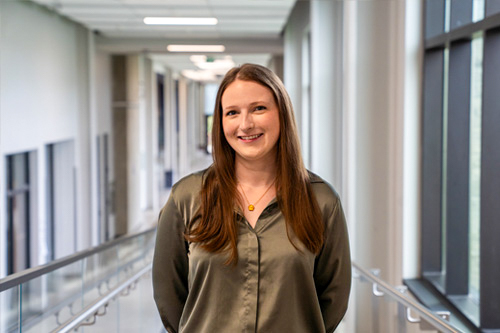 “Receiving the IBET Fellowship is meaningful to me both personally and academically,” said Higgon, a PhD student in electrical and computer engineering, specializing in software engineering. “It feels like recognition of the path I have taken to reach this point, especially because my academic journey has not been completely linear.”
A path that started in high school
Higgon's connection to Western predates her undergraduate degree. She began taking courses there while still in high school through the WISE Program, starting with astronomy and later adding first-year Japanese and an engineering programming course. She went on to study software engineering while also completing degrees in astrophysics and Japanese studies.
“Those areas are very different, but I think studying all three taught me that I enjoy working across disciplines and approaching problems from different perspectives,” she said.
Higgon entered graduate school at the master's level and completed a year of study before transferring into the PhD program. “During that year, I realized that I wanted the opportunity to take on a larger research problem and develop a direction that was more distinctly my own,” she said. “A PhD gives me the time to build deeper expertise while bringing together the technical skills I developed through engineering with the areas of science that have interested me for a long time.”
From lunar dust to deep-space data
Supervised by professor Kenneth McIsaac, Higgon's graduate research has focused on computer vision and synthetic data for space applications, including a project that uses Unreal Engine to build simulated lunar environments and synthetic imagery for training and evaluating machine-learning systems. One part of her work involved developing a procedural method for adding different levels and patterns of dust contamination to simulated objects.
As she begins her PhD research, Higgon is exploring how the image-processing and machine-learning techniques from that work can be applied more broadly to astronomical and space-science data, with a particular interest in helping researchers find patterns and extract information from increasingly large scientific datasets.
“I would like my work to contribute methods that help researchers identify useful patterns, classify information or discover features in those datasets more efficiently,” she said.
Higgon says IBET's support has eased her transition from master's work into the PhD. “Research can change significantly over the course of a graduate degree, particularly at the beginning of a PhD when you are still identifying the questions you want to spend several years answering,” she said. The fellowship, she added, gives her room to read outside her immediate area, connect with researchers in other fields, attend conferences and explore research directions without feeling that every step has to produce an immediate result.
She also values what the program represents more broadly. “It is meaningful to be part of a program designed to support Indigenous and Black students pursuing advanced engineering research,” she said. “Programs like IBET can make graduate studies feel more accessible and create opportunities for students who may not otherwise see themselves represented in these spaces.”
Her advice to students considering graduate studies: don't wait for a fully formed thesis idea. “I would tell students that they do not need to know exactly what their thesis will be before they begin graduate school,” she said. “Having a general area that interests you is useful, but part of graduate research is learning enough about a field to discover which questions are actually worth asking.” She also encourages students not to dismiss interests that don't fit neatly into one discipline and to choose a research environment where they “feel comfortable learning, asking questions, and changing your mind.”
Looking beyond her PhD, Higgon hopes the fellowship helps her build both a meaningful body of research and the expertise and collaborations to keep working on large-scale scientific data, “whether that is in academia, research, or the space industry.”
Towards the future of engineering
Moniz and Higgon arrive at the IBET Momentum Fellowship from different corners of engineering, one working to bring more reliable, low-carbon electricity to remote and Indigenous communities, the other building the computer-vision tools that help scientists make sense of lunar and astronomical data. Both see the fellowship as more than financial support: a foundation that gives them room to pursue research directions that are genuinely their own, and a community that reflects a broader range of voices in STEM.