Media
Contact
Communications Specialist
Faculty of Engineering
Spencer Engineering Building
Room 2072
Western University
Tel: 519-661-2111 ext. 87015
Email: engineeringcomms@uwo.ca
Western Engineering student gains global research experience in Greece
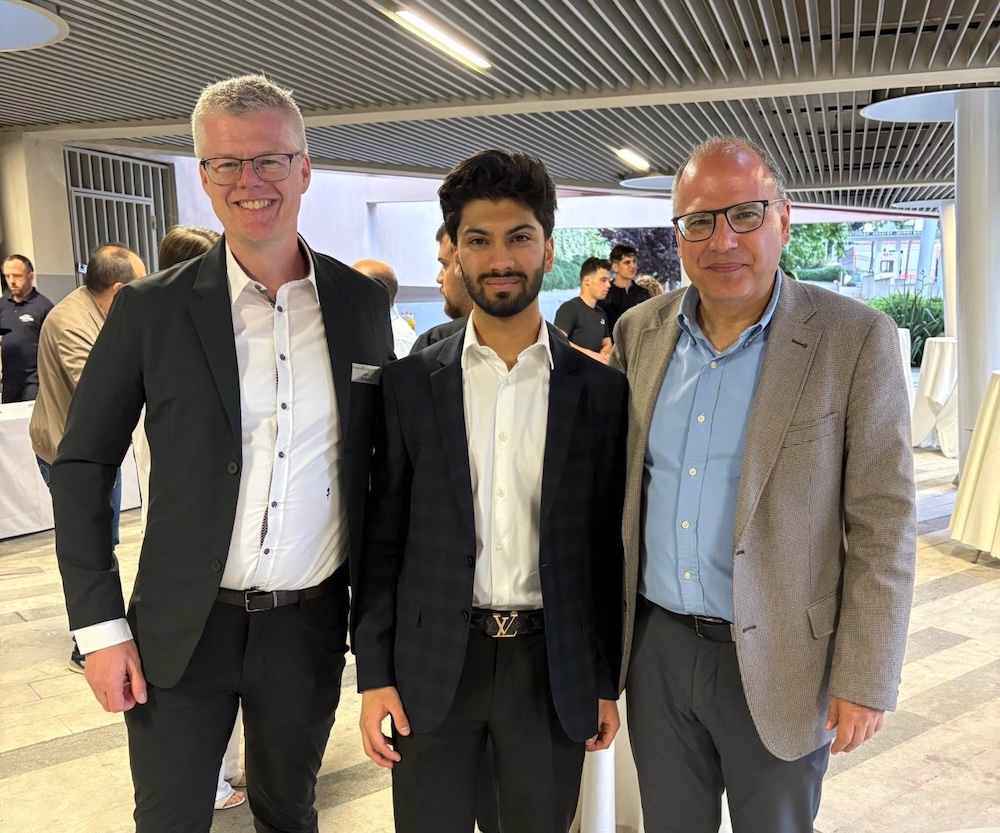
Lars Rehmann, associate dean, graduate and postdoctoral studies office at Western Engineering, Bijan Virani, first-year engineering student and Ivey Business Advanced Entry Opportunity candidate and Panos Seferlis, professor, school of mechanical engineering in the machine dynamics laboratory, Aristotle University of Thessaloniki (L-R), at a reception in Greece. (Submitted)
This past summer, Bijan Virani, a first-year engineering student and Ivey Business Advanced Entry Opportunity candidate, traded lecture halls for a laboratory in Thessaloniki, Greece, spending just under three months conducting cutting-edge carbon capture research alongside a team of PhD researchers.
The opportunity came through Lars Rehmann, associate dean and Kristen Edwards, manager, graduate and postdoctoral studies office at Western Engineering and was additionally funded by the Dean's Award.
Virani worked with the Machine Dynamics Laboratory and professor Panos Seferlis at Aristotle University of Thessaloniki. Back at Western, he worked under Andrew Hrymak, professor in the department of chemical and biochemical engineering, to translate that research into six case studies for the third-year Chemical Engineering Staged Separations course.
“This was such a unique opportunity because it is not often that, as a first-year student, you are able to work on and participate in cutting-edge, real-world research alongside a PhD team,” Virani said, who is now entering his second year.
His research focused on an emerging carbon capture technology using rotating packed beds, which allow carbon dioxide from flue gas to be absorbed more efficiently by a liquid solvent than with conventional, non-rotating equipment. Drawing on five different industrial applications, such as quicklime plants, cement plants, pulp and paper plants, natural gas power plants and refineries, Virani developed five application-specific case studies, plus one introductory case study on the carbon capture industry, for use in Western classrooms and can be used at Aristotle University as well.
Virani also wove an economic lens through the technical work, applying financial concepts from his Ivey coursework, including net present value and payback period calculations, to evaluate the technology's viability. Factoring in capital and operating expenditures, along with the revenue and savings available through the EU's carbon allowance system, he found the technology profitable across all five industries at the facility level. He's careful to note the limits of that finding: real-world factors like carbon transportation costs, facility location and commodity prices could still affect the economics of a full-scale system. Even so, he sees it as a strong signal for the technology's future.
“I think this is a significant conclusion,” Virani said. “When the economics of a technology make sense, companies are much more likely to implement it, which ultimately makes it easier for technologies like this to have a positive impact on climate change.”
“Having my work involve both a technical and economic analysis of this technology completely reshaped my understanding of engineering,” he added. “I now understand that just as important as creating a technology is understanding whether it is maintainable, financially feasible and implementable within existing infrastructure.”
Virani's research went beyond spreadsheets and literature reviews. He toured the Centre for Research and Technology Hellas to see, in person, the machine his case studies were built around, an experience he says deepened his understanding of the technology and its potential impact far beyond what diagrams and papers could offer on their own.
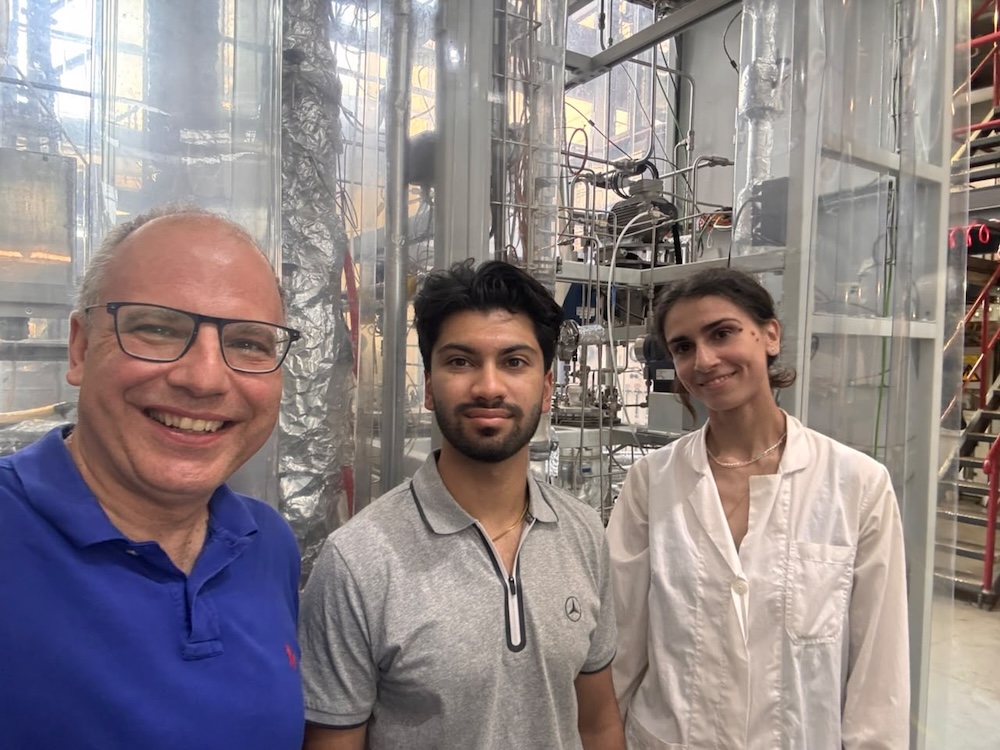
Seferlis, Virani and Elena Nikolaidou, PhD candidate in mechanical engineering (L-R), stand in front of the laboratory-scale Rotating Packed Bed carbon capture system at the Centre for Research and Technology Hellas in Thessaloniki, Greece. (Submitted)
Day-to-day, Virani worked alongside PhD researchers and professionals at the Machine Dynamics Laboratory, reading the team's published research and independently developing his case studies. Lunches with the team became a daily ritual of cultural exchange — over gyros, chicken souvlaki, tzatziki and gelato — and a window into a different way of living.
“The team in Greece was incredibly welcoming and kind to me,” Virani said. “Even though I was five to ten years younger than most of them, they made me feel like part of the team, which made the experience so much better.”
One cultural difference in particular stuck with him: the emphasis many of the people he met placed on health, family, and enjoying life, something he found refreshing.
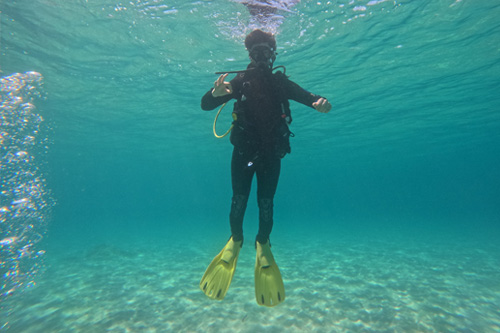 Outside the lab, Virani built a routine of daily trips to the gym and weekend trips to the beach, along with solo travel to Malta and London, hiking, and even scuba diving.
Looking ahead, Virani plans to specialize in integrated engineering and complete the five-year Ivey Business dual degree program. He hopes to bring his engineering background into a career in finance, using the technical perspective he has developed to better understand industries, technologies and infrastructure.
The experience left him with a much deeper understanding of the world of engineering research and a greater appreciation for the scale of the work behind the technologies and infrastructure people often take for granted.
“It can be easy not to think about the environment when the effects of climate change may not be obvious in our everyday lives,” Virani said.
“This experience gave me a much better understanding of all the work happening behind the scenes, and how important technologies such as carbon capture are going to be in the future to mitigate the effects of climate change.”