Media
Contact
Communications Specialist
Faculty of Engineering
Spencer Engineering Building
Room 2072
Western University
Tel: 519-661-2111 ext. 87015
Email: engineeringcomms@uwo.ca
Thompson Fellow explores engineering solutions to global food shocks
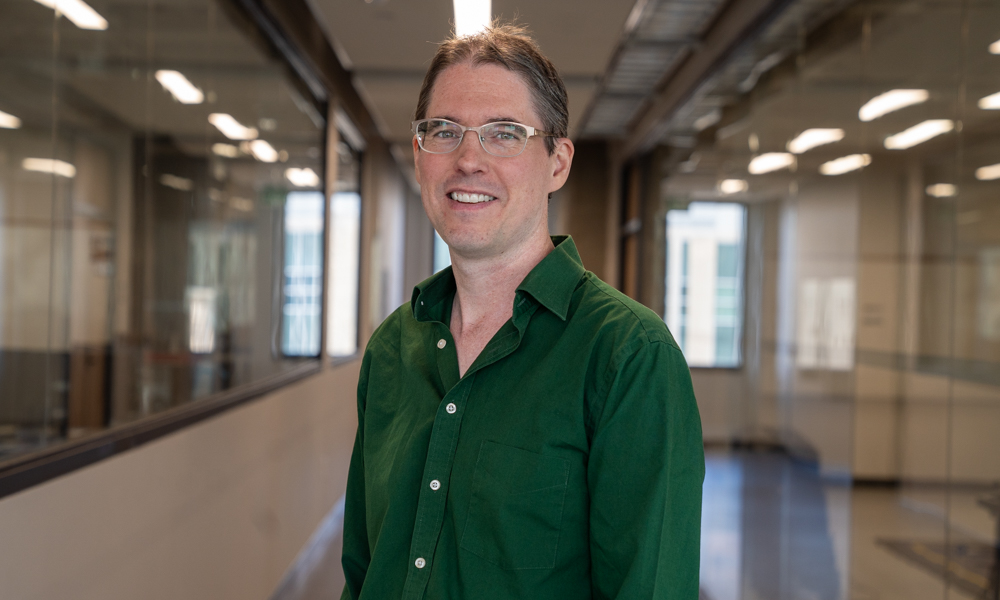
David Denkenberger, professor of mechanical engineering at the University of Canterbury in New Zealand, is Western’s newest Thompson Fellow. (Ayan Boghani/Western Engineering)
What would it take to feed the world if sunlight were blocked for years?
For David Denkenberger, Western’s newest Thompson Fellow, that question has led to a career exploring how engineering can help communities prepare for some of the world’s most severe disruptions.
A professor of mechanical engineering at the University of Canterbury in New Zealand, Denkenberger is co-founder and research director of the Alliance to Feed the Earth in Disasters (ALLFED). The multinational nonprofit identifies resilient food solutions and helps governments and communities prepare to implement them during a global food shock.
As a Thompson Fellow, Denkenberger brings an interdisciplinary perspective to the Western Engineering and Ivey Business School community, connecting engineering problem-solving with questions about preparedness, cooperation and the implementation of new ideas.
ALLFED studies how food could be produced during what researchers call abrupt sunlight reduction scenarios, including major volcanic eruptions, asteroid impacts or the atmospheric effects of nuclear war.
"A lot of my research is looking at what people have already done and asking how this could work in a catastrophe," says Denkenberger.
“I started with mushrooms and expanded into all sorts of food supplies that might work in no sunlight or reduced sunlight.”
His research considers both adaptations to conventional agriculture and alternative ways to produce food when normal growing conditions are disrupted.
“There are conventional things like just moving crops closer to the equator, where it’s warmer and where there would be more light, or using greenhouses,” says Denkenberger. “But then there’s more exotic things like turning wood into sugar.”
One possibility involves adapting technologies used in second-generation biofuel plants. These facilities break down cellulose in agricultural residues, such as corn stalks, into sugars before converting those sugars into ethanol.
“If what we need is food, then we should stop there and not turn it into ethanol,” he says.
Other approaches include protein produced by microorganisms that consume hydrogen or natural gas, alongside expanded seaweed cultivation.
According to Denkenberger, seaweed could be particularly useful in a cooling scenario. As surface waters cool and sink, deeper water could rise, bringing nutrients to the surface.
“We actually found that seaweed would grow better in a catastrophe like this than right now,” he says.
“But there are a lot of advantages of working with seaweed even now because it doesn’t require irrigation and usually does not require pesticides or fertilizers.”
Some alternative proteins are already being produced commercially, but Denkenberger wants to understand how production could be expanded rapidly during an emergency.
“What we want to do is do an actual pilot project, which would be more like a catastrophe scenario, because they’re not thinking about how to scale these things up fast,” he says of companies already producing some of these alternative proteins.
Preparedness also requires coordination beyond the laboratory. Denkenberger says ALLFED has worked with Argentine and Australian Governments to develop response plans for abrupt sunlight reduction scenarios.
“What we found is that both of those countries, we think, could not only feed themselves in a catastrophe, but also continue to export food,” he says.
Maintaining those exports could help countries obtain essential supplies in return, including oil, while supporting food availability elsewhere.
“We do want to emphasize how continued cooperation is really important in these catastrophes.”
For Denkenberger, working across these interconnected challenges draws directly on his engineering education.
“My undergraduate major was actually engineering science,” he says. “And so that was all different types of engineering.”
“I do credit my engineering education to be able to work across disciplines.”
While the events ALLFED studies may be unlikely in any given year, Denkenberger argues that their combined risk over time makes preparedness and resilience worthwhile.
“The probability per year of any one of these catastrophes is fairly low. But when you think about many different catastrophes and over decades, it does add up,” he says.
“Another advantage of resilience is we could be prepared for something we don’t even know about yet.”