Media
Contact
Communications Specialist
Faculty of Engineering
Spencer Engineering Building
Room 2072
Western University
Tel: 519-661-2111 ext. 87015
Email: engineeringcomms@uwo.ca
Scott Shawyer: One Canadian, three oceans
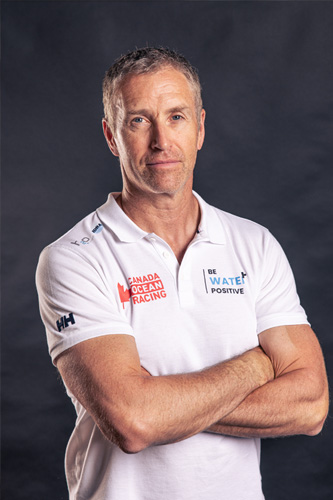 Engineering Communications spoke with Scott Shawyer, BA’94, BESc’96, about what drives him to pursue the Vendée Globe, how his engineering background shapes his preparation and what he believes people are truly capable of. This is his story.
It was November 2020 and Scott Shawyer was twelve hours into another day of Zoom calls. COVID had compressed his world to a screen. He was working around the clock, trying to raise money for his company, and life — by every measure — was going well. He had a family, a thriving career and a business he had built from the ground up. He was also, though he hadn’t quite admitted it to himself yet, running on autopilot.
Then he saw the start of the 2020 Vendée Globe. The skippers walked down the dock in Les Sables-d’Olonne wearing masks. They reached their boats, cast off and the masks came off. Thirty-three sailors set out alone, headed for the bottom of the world.
“It was just this huge sense of freedom that I felt,” Scott recalls. “And this exhilaration that I hadn’t felt in a long time.”
That image didn’t leave him. “The comfortable side of my life had become too comfortable,” he says. “And it was becoming uncomfortable.”
A goal worth trying
Scott started researching Canada’s history with the Vendée Globe and found it thin and painful. Gerry Roufs had attempted the race in 1996 and never came home. Derek Hatfield tried and suffered a knockdown in the Southern Ocean, forcing a retirement. No Canadian program had built a sustained presence in the race. When Scott began sharing his intentions, the response from those around him was predictable.
“A lot of people said it couldn’t really be done. Too expensive, too difficult from Canada, too wild a goal.” He pauses. “The more people said I couldn’t do it, the more I felt like I ought to try.”
The Vendée Globe is a solo non-stop round-the-world yacht race — no pit stops, no crew, no assistance. Competitors cross three oceans, round three capes and sail through some of the most violent weather on earth. Race times run to roughly 80 days. Scott is aiming to be the first Canadian to finish it.
A steep learning curve
More than halfway to the 2028 race start, Scott is candid about how much he underestimated the challenge. These are not sailboats in any conventional sense — they are stripped down carbon fibre machines riding hydrofoils at speeds up to forty knots, loaded with control systems, canting keels and adjustable foil geometry that demand constant, precise management. Learning to foil has been its own education. So has becoming, out of necessity, a self-taught meteorologist.
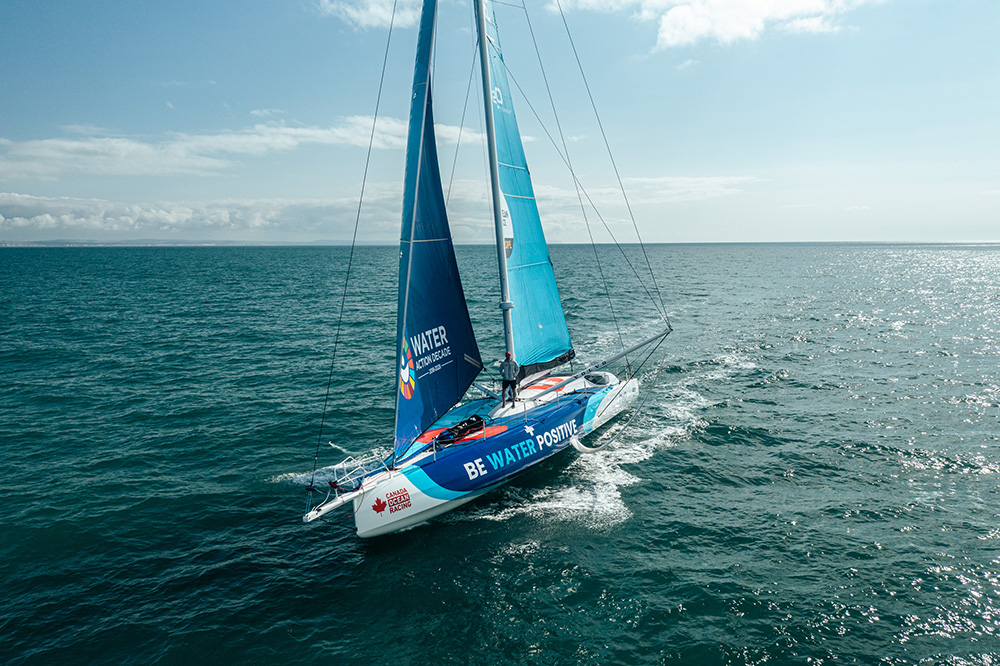
Shawyer aboard Emira IV during open water training. The Western Engineering graduate is aiming to become the first Canadian to complete the Vendée Globe in 2028. (Photo submitted)
There have been surprises. “I’ve learned that I get seasick,” he says, with evident amusement. “Who would have thought a sailor gets seasick — especially one attempting to sail around the world?” He is working on strategies. He has also discovered something about how he learns: “I don’t take direction very well. I’m a thinker. I need to understand why something works. If somebody can’t tell me why, I need to try it and figure it out for myself.”
“The more people said I couldn’t do it, the more I felt like I ought to try.”
Engineering as a superpower
At any given moment on the water, Scott is managing the trim and shape of the foresail, the selection of sails, weight distribution, water ballast position, canting keel angle and foil rake extension — all of it tuned toward a single output: speed in the current conditions. It is, he says, exactly the kind of problem his engineering training prepared him for.
“It’s a huge complex problem that we’re always solving when we are sailing,” he says. “And it’s what makes this so enjoyable.”
The engineering mindset shows up off the water too — in the maintenance of the boat, the troubleshooting of systems and the understanding of the dynamic forces between hull, foil and sail. “Systems thinking, problem solving under pressure, managing complexity,” he says. “All of that comes forward in this sport. My engineering background is a huge strength.”
Preparing for the Southern Ocean
The physical demands of the Vendée Globe are matched by its psychological ones. Scott has assembled a coaching team that includes a mental performance coach and a man who rowed from Hawaii to Australia in over 200 days. He is learning to sleep in short, efficient cycles — slowing his heart rate, engaging his parasympathetic nervous system and dropping into something close to meditation on demand. (“My wife has also helped me prepare for this,” he notes, “because she’s a very restless sleeper — so I’m constantly being woken up and falling back to sleep.”)
One of his coaches works with military personnel stationed in confined, high-stakes environments for days at a time — people sitting in tanks, waiting, with no clear picture of what’s coming. The parallel to a solo sailor in the Southern Ocean, Scott says, is more direct than it might seem. Together they are working through every scenario that could destabilize him: isolation, loneliness and fear. They name each one, map what he will be thinking and feeling and build a response.
Be water positive
Canada Ocean Racing carries a mission alongside the sailing. The boat is branded “Be Water Positive” — a concept that goes beyond carbon neutrality. Where carbon neutral asks organizations to minimize harm, being water positive asks them to do more good for water systems than the harm they cause: treating and returning water to a higher quality than it was taken, rethinking how water moves through communities and demanding better from the technologies already available to us.
For Scott, the race is a platform to carry that message around the world — literally. “It really takes people understanding that we do have that technology, and being accepting of it, and then taking a step further and asking for it.”
Finding out what you’re capable of
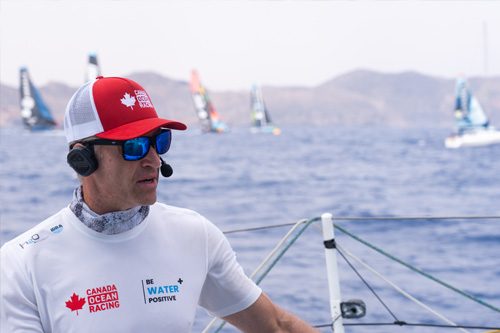 Beneath the race, the boat and the mission, the question Scott is really trying to answer is a simpler one: what am I actually capable of? “I really do believe in setting stretch goals and pushing myself in a quest to learn about myself,” he says. “I’m a bit of a scientist and a guinea pig at the same time — I set up the experiment and then we see what the guinea pig can do.”
To anyone sitting at a desk, feeling the quiet unease of a life running too smoothly, he has one thing to say.
“You can do a whole heck of a lot more than you think you can. Your courage to do and take on big challenges comes way before your confidence that you can do them. Once you’re okay with the worst-case scenario, having unreasonable confidence in yourself can pay huge dividends. You will figure it out as you go.”
He found that out watching a group of sailors remove their masks on a dock in France and sail away from everything familiar. In 2028, he plans to do the same.