Media
Contact
Communications Specialist
Faculty of Engineering
Spencer Engineering Building
Room 2072
Western University
Tel: 519-661-2111 ext. 87015
Email: engineeringcomms@uwo.ca
From concept to impact: Western Engineering students shine at Design Day
Western Engineering’s graduating students demonstrated their creativity, technical expertise and problem-solving abilities at Design Day 2026. This year’s collaborative showcase brought together capstone projects from across multiple programs, including Electrical Engineering, Mechatronic Systems Engineering, Software Engineering, Integrated Engineering, and Mechanical Engineering.
In addition, Design Day 2026 marked a significant milestone with the inclusion of projects from the first graduating class of the Artificial Intelligence Systems Engineering program, highlighting the faculty’s continued growth in emerging and interdisciplinary fields.
Over the course of seven months, students work collaboratively to transform complex problem statements into fully realized engineering solutions. From early concept development to final prototypes, teams deliver comprehensive design packages that include manufacturing plans, cost analysis, testing and iterative improvements—culminating in presentations to faculty, industry partners and the broader community.
Student teams presented a diverse range of projects, reflecting both technical excellence and a strong commitment to addressing real-world challenges across healthcare, accessibility, sustainability and advanced manufacturing.
Advancing Medical Technology with Thornhill Medical
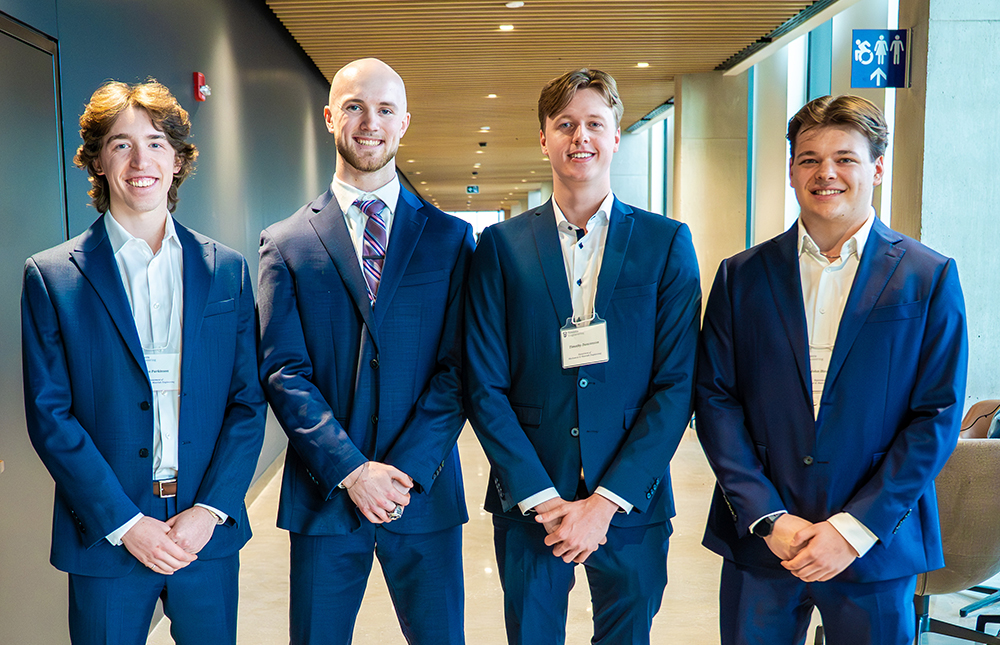
Students: Ryan Parkinson, Ayden Blain, James Duncanson and Jack Binder
Students collaborated with Thornhill Medical to enhance the MOVES SLC, an integrated life support system used in global emergency and military medicine. While the device already provides critical oxygen delivery and ventilation, the team focused on optimizing the patient monitor subassembly, which houses the electronics that read vital signs.
By exploring innovative material applications and mechanical adjustments, the team developed design modifications that improved durability and mounting stability. Their final recommendations reduced overall weight while ensuring the MOVES SLC remains a resilient, cutting-edge solution for portable critical care.
Autonomous AI-Enabled Lawn Mower for Safer, Smarter Residential Lawn Care
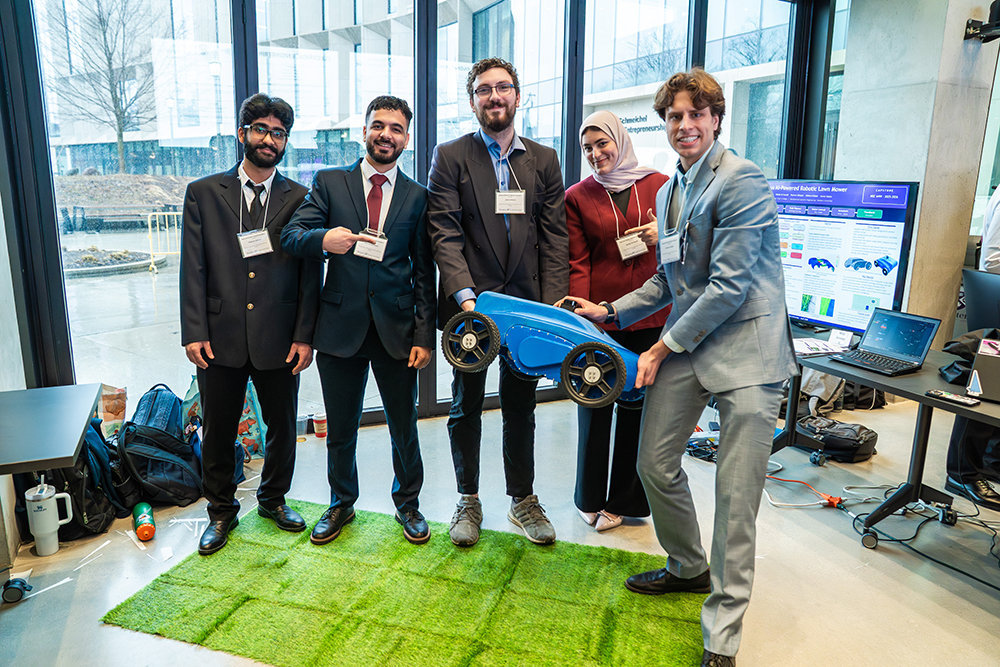
Students: Pedram Ghiassi, Hamza Aldraimli, James Keane, Malak Al-Hanafi and Aliaksei Kabak
This team developed a fully autonomous, boundary-free robotic lawn mower designed to make lawn care safer, more accessible and less time-consuming. Addressing the limitations of existing systems, such as reliance on boundary wires and high costs, the mower uses computer vision, LiDAR, ultrasonic sensing and onboard control to navigate real residential environments.
The system can distinguish grass from non-traversable areas, detect obstacles including people and pets and operate safely without perimeter wiring. Featuring a four-wheel-drive chassis, custom cycloidal gearboxes and a guarded cutting system, the design ensures reliable performance on uneven terrain. By validating motion control and perception systems in simulation before hardware testing, the team delivered a practical and intelligent lawn care solution with strong real-world potential.
AccessScan: Improving Accessibility through Smart Assessment
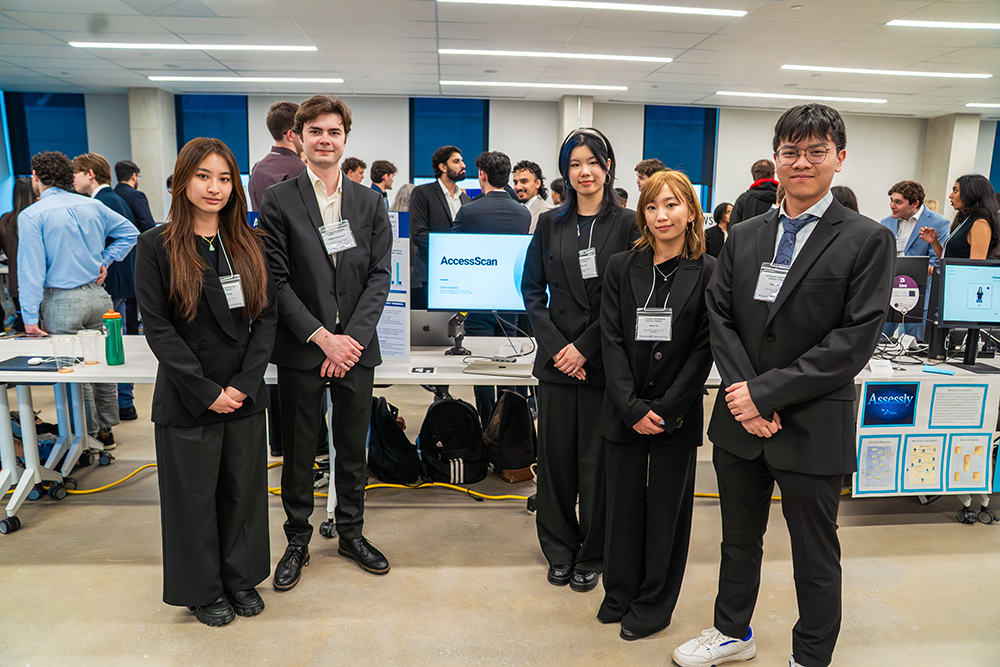
Students: Tiffany Trinh, Stepan Hartanovich, Jennifer Shi, Anna Liu and Ryan Huang
Recognizing that accessibility compliance does not always equate to usability, this team developed AccessScan—a mobile app that transforms a simple washroom scan into a structured accessibility assessment.
Users can record a space using their smartphone, and the app processes the scan to identify key features such as grab bars and toilets, measure spatial layouts and generate a clear report. The system simplifies what is traditionally a manual and inconsistent process, offering actionable insights into whether a washroom meets accessibility requirements and what improvements are needed.
Designed for ease of use without specialized expertise, AccessScan empowers users to make faster, more informed decisions, ultimately supporting safer, more inclusive environments.
Home Flood-Risk Monitoring System
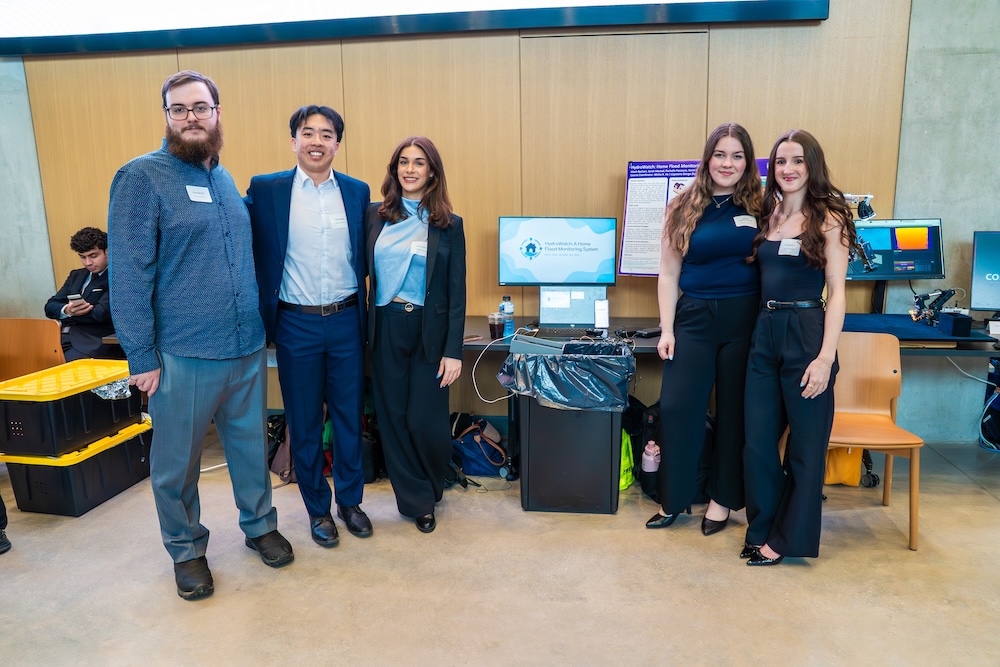
Students: Benjamin Bell, Kevin Shang, Sarah Massad, Rachelle Darwin Paczesny and Meah Bachert
To address the growing challenge of basement flooding, this team developed a home flood-risk monitoring system that provides early warning of potential water intrusion.
The system uses four in-ground soil moisture sensors positioned around a home’s foundation to track subsurface conditions. Data is transmitted to the cloud, where a risk model analyzes soil saturation, moisture trends and rainfall forecasts to generate a real-time risk score.
Delivered through a mobile app, the system allows homeowners to receive alerts, monitor changing conditions and better understand their flood risk—enabling proactive measures to reduce potential damage.
Synchronous Wheel Dolly System for Indoor Vehicle Movement
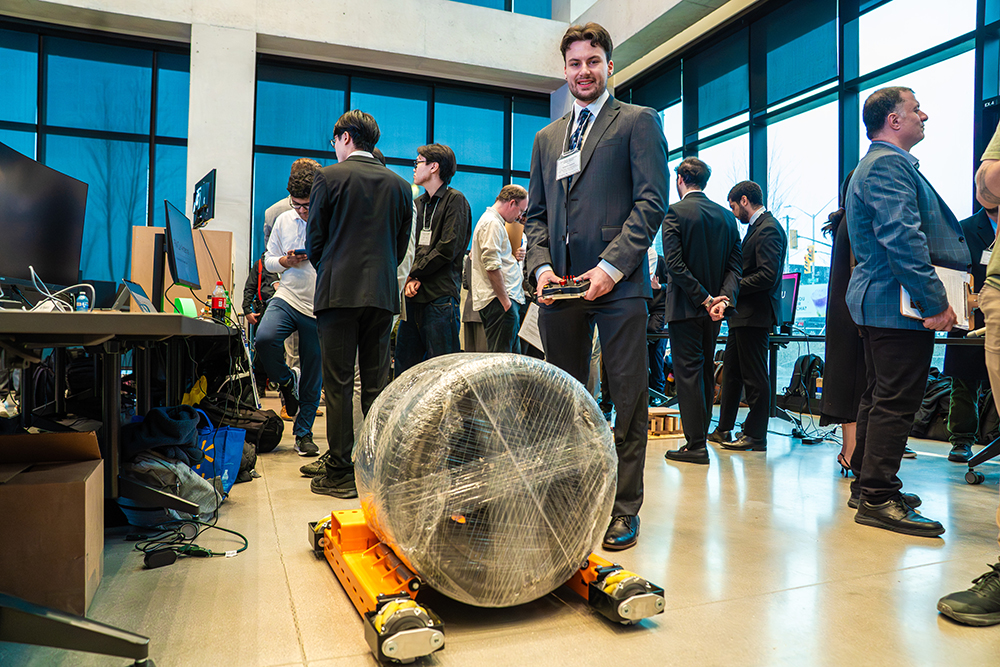
Students: Benjamin McGinnis, Nick Salgado and Eric Reci
Developed in collaboration with TRAX Power Dolly Systems, the “Sidewinder” offers a solution for safely and efficiently moving vehicles within warehouse environments.
The system allows users to independently position units under each tire before synchronously lifting the vehicle, enabling movement of up to 10,000 pounds in all directions. By reducing the need for large clearance spaces and improving operator control, the design minimizes the risk of damage during repositioning.
With potential applications in both the automotive and aviation industries, the Sidewinder demonstrates how thoughtful engineering can improve safety and operational efficiency.
Celebrating engineering excellence
Each project presented at Design Day reflects the dedication, collaboration and ingenuity of Western Engineering students.
Beyond technical achievement, Design Day serves as a bridge between academia and industry—highlighting how students apply their knowledge to solve meaningful, real-world problems. From advancing life-saving medical technologies and improving home safety to enhancing accessibility and automation, these projects demonstrate the far-reaching impact of engineering innovation.
As Western Engineering continues to foster experiential learning and industry collaboration, Design Day remains a defining milestone—preparing graduates to lead, innovate and make a lasting difference in their fields and communities.