Media
Contact
Communications Specialist
Faculty of Engineering
Spencer Engineering Building
Room 2072
Western University
Tel: 519-661-2111 ext. 87015
Email: engineeringcomms@uwo.ca
First PhD, lifelong pioneer: Peter Castle on research, green energy and Western's legacy
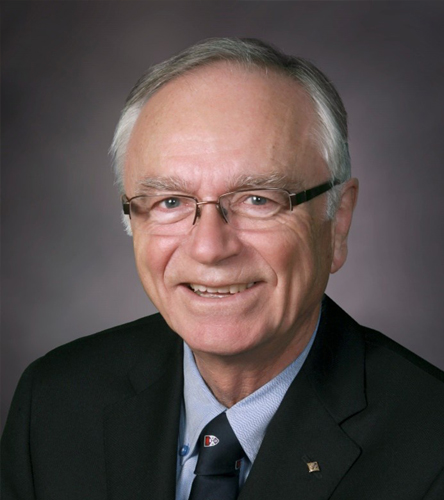 When Peter Castle BESc’61, PhD’69, sat down with professor Stuart Lauchland in a basement office in Thames Hall in 1957, he had come intending to study Geology. He left having enrolled in Engineering Science and set in motion a connection with Western that would span more than six decades. In 1969, Castle became the first student to earn a PhD in Engineering at Western, a milestone that marked not just his own achievement but the maturation of the Faculty’s research mission. What followed was a 50-year career defined by teaching, research and a quiet conviction that the world’s energy future needed to change — long before that view was widely shared. In the years after his retirement, he co-authored Expansion & Innovation: The Story of Western Engineering 1954–1999 with George S. Emmerson, ensuring the Faculty’s founding history would not be forgotten.
That instinct to give back runs deep. In 2025, Peter and his wife Judy established the George E. Castle Award in Engineering — a gift in memory of Peter’s father, George E. Castle, who gave up an established career in Belfast, Northern Ireland to immigrate to London, Canada so that Peter and his sister Susan could build their futures at Western. The award supports Indigenous undergraduate students based on financial need and academic achievement, a legacy rooted in the belief, carried across an ocean, that access to education changes everything.
Engineering Communications spoke with professor emeritus Peter Castle to learn about the genesis of the Faculty’s PhD program, green energy and Western's legacy.
As the first Engineering PhD student at Western, what was the research environment like — what did you have to figure out as you went?
Initially, all Faculty members in Western Engineering were solely engaged in undergraduate teaching rather than in research. When Dean Dick Dillon was hired in 1960, one of his mandates was to expand the program into graduate studies. He showed great judgement in hiring new faculty who showed potential as researchers in specific areas not duplicated at other Ontario universities. As an early student, the two main problems were getting financial support and ensuring recognition of the quality of our work.
In my case, having worked for two years in industry and supporting a family with two young daughters, I needed secure funding. Fortunately, I was eligible for a special NSERC program aimed at supporting post-industrial experience in research. This, along with grant support for my project in environmental engineering, provided modest but adequate financial support. This, along with the encouragement and self-sacrifice from my dear wife Judy, made my graduate studies possible.
Since Western Engineering had only started its graduate program, it was critical to ensure that the quality of the work undertaken was first-class. In my case, I was slightly intimidated but also honoured to find that my supervisor, professor Ion Inculet, had selected as my external PhD examiner professor Harry J White, then the world’s most distinguished scholar in electrostatic precipitation, my field of research. I was, of course, delighted when he reaffirmed the significance of our contributions.
Your course on Direct Energy Conversion — essentially green technology before that term existed — ran for over 30 years. What was it like championing that subject when it was far from the mainstream, and how do you feel seeing it at the centre of the conversation today?
Shortly after graduation with my Bachelor’s degree in 1961, Rachel Carson published her revolutionary book “The Silent Spring,” in which she alerted us to the devastation to our natural world caused by unhindered environmental pollution. This influenced me greatly and was instrumental in changing my career path from microwave communications engineering into environmental engineering. This is what brought me back to Western, since it became an early emphasis of the graduate program here, which initially included wind engineering, soil mechanics, fluidization and applied electrostatics.
When hired on Faculty as a lecturer in 1968, I was initially assigned undergraduate teaching duties in the traditional required fields of electric circuits and machines. Because of my research interests, I soon developed a fourth-year elective course dealing with alternate forms of electric energy generation to replace the polluting coal-fired power stations then widely in use. Topics included solar, wind and nuclear power systems, fossil fuel reserves, and the greenhouse effect.
So, on the one hand, while I am delighted to see that there is finally widespread recognition and acceptance of the need to reduce our dependency on carbon-emitting fuels, I fear that the level of urgency has not yet been fully recognized and certainly not widely acted upon. Time is of the essence.
What does it mean to you personally to see the Faculty’s history now commemorated on the Legacy Wall?
I was delighted to see this initiative from Dean Ken Coley and was honoured to be part of the dedication ceremony in May 2025, in which the names of 70 retirees were unveiled.
Also, I was very happy to see that, along with the faculty members who had spent 25 years or more in service to Western Engineering, it also included members of the administrative and technical support staff. As a faculty member, I know very well how much we and our students depend upon the dedication and expertise of staff members. This recognition was long overdue.
As part of the ceremonies, I was asked to share my career story in Western Engineering. It was nostalgic to realise that because of my history here, I personally knew every name on the wall. Each name represents a unique life story, different in detail from mine, but similar in that we all owe so much to the career success that came from our UWO experiences.
I know that all of us would be proud to see that subsequent generations of Faculty and Staff have built on this legacy to turn Western Engineering into the centre of engineering excellence that it is today. As we await completion of yet another new building, which will make five buildings in all, we have come a long way from my initial meeting in 1957 with professor Stuart Lauchland, the founding Chair, in his office in the basement of Thames Hall!