
Media
Contact
Communications Specialist
Faculty of Engineering
Spencer Engineering Building
Room 2072
Western University
Tel: 519-661-2111 ext. 87015
Email: engineeringcomms@uwo.ca
A community partnership takes flight with 3D-printed raptor puppets
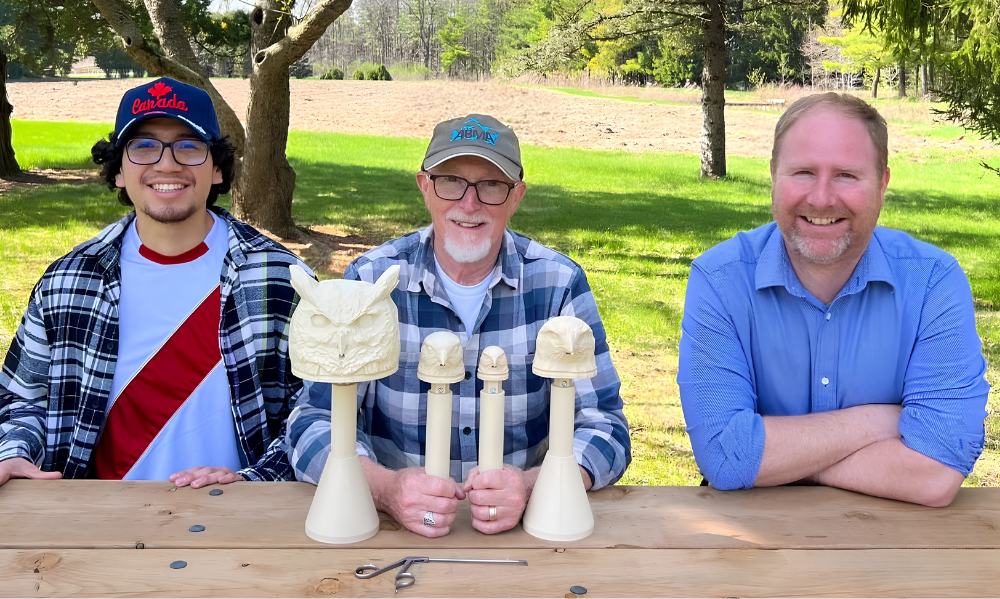
Joel Sierra, a visiting undergraduate student at Western Engineering, with Brian Salt, founder of Salthaven Wildlife Rehabilitation and Education Centre, and Ryan Willing, professor in the department of mechanical and materials engineering. (photo courtesy of Salthaven)
Four new feeding puppets at Salthaven Wildlife Rehabilitation and Education Centre will help caregivers feed young raptors while reducing their contact with people when baby season returns next year.
Created through a collaboration with Western Engineering, the 3D-printed puppets resemble a Great Horned Owl, Merlin, Red-tailed Hawk and American Kestrel Falcon. They are designed to encourage nestlings to associate food with their own species rather than people — an important part of preparing these young patients for a return to the wild.
“Birds get along in the wild by learning from one another by example and when they don't have one another to learn from, then their chances of survival are pretty slim,” says Salthaven founder Brian Salt. “Our mission is to help rehabilitate sick, injured or orphaned wildlife and return them to the wild so that they can sustain themselves there.”
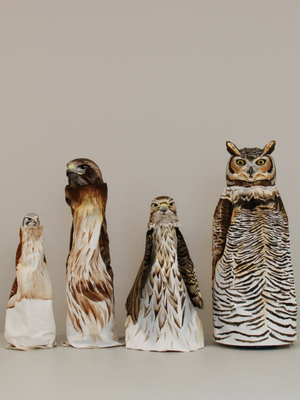
The puppets help preserve that connection to their own species by giving young birds a familiar-looking face at feeding time. Caregivers can offer food through the puppet’s beak while keeping their hands concealed, and recordings of parent birds’ calls help make the experience more realistic.
“Feeding them with a puppet, it takes away that human element and allows them to relate to their own kind a whole lot better,” says Salt. “It increases their chances of survivability in the wild substantially.”
Previously, caregivers wore reflective masks and gowns to obscure their human form during repeated daily feedings. Salthaven also used a rudimentary Great Horned Owl puppet, but feeding required reaching around its face to offer food. The new designs allow feeding forceps to pass through the head and out beneath the beak.
The project is the latest development in a partnership that connects hands-on student learning with the needs of a local wildlife rehabilitation centre.
The collaboration began with a Western Engineering capstone team that designed specialized leg splints for injured Canada Geese and Mallard ducks. Thanks to a donated 3D printer, Salthaven is now able to reproduce the splints itself.
That relationship opened the door to the feeding puppets. Joel Sierra, an undergraduate student from Lima, Peru, designed and printed the puppet heads while at Western as a visiting researcher, incorporating feedback from Salt.
A local artist then painted the heads and canvas sleeves to match each species, transforming the printed forms into convincing stand-ins for raptor parents. Salthaven also received the digital designs so it can print additional heads as needed.
“Working with Salthaven is always interesting, enriching and a lot of fun,” says Ryan Willing, professor in the department of mechanical and materials engineering, who supervised the engineering teams for both projects.
“From designing 3D printable splints for waterfowl, to creating realistic bird head puppets for feeding fledglings, it’s wonderful to watch students spread their wings and apply their engineering expertise to solve challenging real-world problems impacting wildlife in our local communities.”


