-
Atomic Layer Deposition (ALD) and Molecular Layer Deposition (MLD) for Interface Design
|
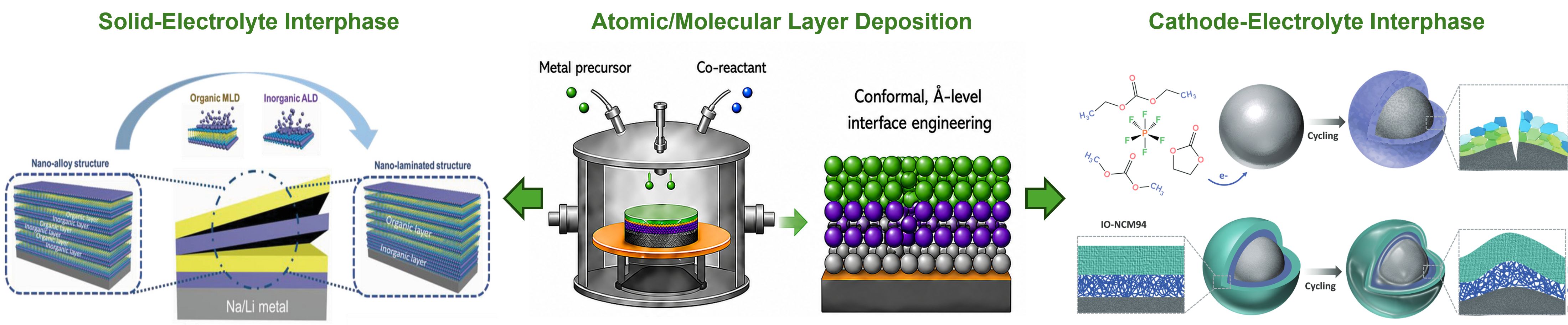 |
| Atomic layer deposition (ALD) and molecular layer deposition (MLD) provide powerful, precision-controlled approaches for interfacial engineering for batteries. By enabling conformal, ultrathin, and chemically tunable coatings on complex electrode surfaces, ALD/MLD can be used to stabilize both cathode–electrolyte and anode–electrolyte interfaces. On the cathode side, artificial interfacial layers can suppress electrolyte decomposition, mitigate transition-metal dissolution, reduce surface reconstruction, and improve Na⁺ transport across the interface. On the anode side, ALD/MLD-derived coatings can regulate solid-electrolyte interphase formation, inhibit parasitic reactions, accommodate volume change, and enhance interfacial compatibility with liquid or solid electrolytes. Through rational control of coating composition, thickness, and hybrid organic–inorganic chemistry, ALD/MLD offers a versatile platform to understand and design stable electrode interfaces for high-performance and long-life batteries. |
|
Representative work:
- J. Olowoyo, V. Gharahshiran, Y. Zeng, Y. Zhao*, and Y. Zheng*, Atomic/Molecular Layer Deposition Strategies for Enhanced CO2 Capture, Utilisation and Storage Materials, Chemical Society Reviews, 2024,53, 5428-5488 (Review)
- Y. Zhao†, L. Zhang†, J. Liu†, K. Adair, F. Zhao, Y. Sun, T. Wu, X. Bi, K. Amine, J. Lu, X. Sun, Atomic/Molecular Layer Deposition for Energy Storage and Conversion, Chemical Society Reviews, 2021, 50, 3889-3956 (Review)
- P. Pirayesh, K. Tantratian, M. Amirmaleki, F. Yang, E. Jin, Y. Wang, L. Goncharova, J. Guo, T. Filleter, L. Chen*, Y. Zhao*, From Nano-Alloy to Nano-Laminated Interfaces for Highly Stable Alkali Metal Anodes, Advanced Materials, 2023, 35, 2301414
- E. Jin, J. Su, H. Hou, P. Pirayesh, Y. Wang, Y. Yuan, H. Yan, G. Popov, L. Goncharova, S. Ketabi, F. Dai, C. Cao*, L. Chen*, Y. Zhao*, Electro-chemo-mechanically Stable and Sodiophilic Interface for Na Metal Anode in Liquid-based and Solid-State Batteries, Advanced Materials, 2024, 36, 2406837
- J. Ma, Y. Sun, D. Wu, C. Wang, R. Yu, H. Duan, M. Zheng, R. Li, M. Gu*, Y Zhao*, J. Zhou*, X. Sun*, Highly Stabilized Ni-Rich Cathodes Enabled by ArtificiallyReversing Naturally-Formed Interface, Advanced Energy Materials, 2025, 15, 2403150
- Y. Wang, H. Hou, K. Tantratian, L. Goncharova, B. Fu, E. Jin, P. Pirayesh, H. Abdolvand, X. Pang, L. Chen*, C. Cao*, Y. Zhao*, Insight into Artificial Interfaces for Li Metal Anode: Organic-rich or Inorganic-rich, Advanced Functional Materials, 2024, 34, 2406426
- E. Jin, H. Hou, Y. Zhao, Y. Wang, C. Zhang, P. Pirayesh, Y. Yuan, Y. Gan, G. Popov, L. Goncharova, S. Ketabi, F. Dai, J. Song*, C. Cao*, Y. Zhao*, Dual-Metal-Sites Decoupling Ionic Transport and Mechanical Reinforcement in Hybrid Interface Toward Stable Sodium Metal Batteries, Materials Today, 2026, 97, 103333
- P. Pirayesh, E. Jin, Y. Wang, Z. Dong, Y. Gan, Y. Yuan, M. Yang, R. Andaveh, F. Holness, S. Chen, L. Chang, X. Pang, Y. Zhao*, Tailored the Polymer Interface of Prussian Blue Analogues for Sodium-ion Batteries, EES Batteries, 2026
- E. Jin, K. Tantratian, C. Zhao, A. Codirenzi, L. Goncharova, C. Wang, F. Yang, Y. Wang, P. Pirayesh, J. Guo, L. Chen*, X. Sun*, Y. Zhao*, Ionic Conductive and Highly-Stable Interface for Alkali Metal Anodes, Small, 2022, 18, 2203045
|
-
Solid-state Sodium-ion Batteries: Electrolyte, Interface and Device
|
|
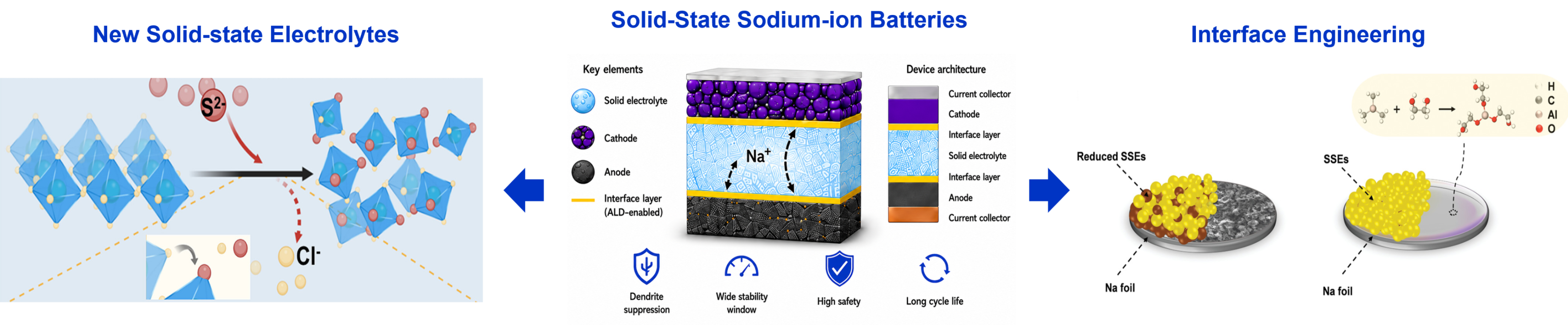
| Solid-state sodium-ion batteries are particularly attractive because they combine the intrinsic resource advantages and low cost of sodium with the enhanced safety potential of nonflammable solid electrolytes. They also offer a promising route to overcome limitations of conventional liquid-electrolyte sodium batteries, including electrolyte leakage, unstable interphases, dendrite-related failure, and restricted operating conditions. Our work on solid-state sodium-ion batteries focuses on the integrated development of solid electrolytes, engineered interfaces, and practical device architectures. A central direction is the design of new solid-state electrolytes, including halide-based materials and dual-/multiple-ion framework systems, to achieve high Na⁺ conductivity, wide electrochemical stability, and improved chemical compatibility with electrode materials. In parallel, we use interface engineering strategies to regulate cathode–electrolyte and anode–electrolyte contacts, reduce interfacial resistance, suppress side reactions, and improve mechanical/electrochemical stability during cycling. By coupling electrolyte discovery with targeted interfacial modification and full-cell device integration, this theme aims to advance safe, long-life, and high-performance solid-state sodium-ion batteries. |
|
Representative work:
- Z. Dong, Y. Gan, V. Martins, X. Wang, B. Fu, E. Jin, Y. Gao, Y. Hu, X. Lin, Y. Yuan, C. Turner, X. Pang, H. Abdolvanda, Y. Huang, T.-K. Sham*, Y. Zhao*, Novel Sulfide-chloride Solid-state Electrolytes with Tunable Anion Ratio for Highly Stable Solid-state Sodium-ion Batteries, Advanced Materials, 2025, 37, 2503107
- Z. Dong, B. Sourav, Y. Gan, V. Martins, X. Wang, A. Mozafarighoraba, R. Zhang, C. Turner, X. Pang, H. Abdolvand, Y. Huang, P. Kaghazchi*, T.K. Sham*, Y. Zhao*, Design of Sodium Chalcohalide Solid Electrolytes with Mixed Anions for All-Solid-State Sodium-Ion Batteries, Advanced Functional Materials, 2026, 36, e16657
- X. Lin†, Y. Zhao†, C. Wang†, J. Luo, J. Fu, B. Xiao, Y. Gao, W. Li, S. Zhang, J. Xu, F. Yang, X. Hao, H. Duan, Y. Sun, J. Guo, Y. Huang, X. Sun, A Dual Anion Chemistry-Based Superionic Glass Enabling Long Cycling All-Solid-State Sodium-Ion Batteries, Angewandte Chemie International Edition, 2024, 63, e20231418
- S. Zhang†, Y. Zhao†, F. Zhao, L. Zhang, C. Wang, X. Li, J. Liang, W. Li, Q. Sun, C.Yu, J. Luo, K. Doyle-Davis, R. Li, T.-K. Sham, X. Sun, Gradiently Sodiated Alucone as an Interfacial Stabilizing Strategy for Solid-State Na Metal Batteries, Advanced Functional Materials, 2020, 30, 2001118
- P. Pirayesh, E. Jin, Y. Wang, Y. Zhao*, Na Metal Anode for Liquid and Solid-state Na Batteries, Energy & Environmental Science, 2024, 17, 442-496 (Review)
- W. Xia†, Y. Zhao†, F. Zhao†, K. Adair, R. Zhao, S. Li, R. Zou, Y. Zhao, X. Sun, Anti-Perovskite Electrolytes for Solid-State Batteries, Chemical Reviews, 2022, 122, 3763–3819 (Review)
|
-
Sodium-sulfur Batteries: From Liquid to Solid
|
 |
| Sodium–sulfur batteries are attractive next-generation energy-storage systems because they couple earth-abundant, low-cost sodium and sulfur with high theoretical energy density, but their practical performance is limited by polysulfide shuttle, sluggish reaction kinetics, unstable interfaces, and safety challenges. Our work on sodium–sulfur batteries spans both liquid and solid-state systems, with a central focus on controlling interfacial chemistry to enable high sulfur utilization, long cycle life, and improved safety. For liquid batteries, we develop interface design strategies to suppress polysulfide dissolution and shuttle behavior, stabilize the sulfur cathode and sodium anode interfaces, and promote efficient redox conversion. For solid-state sodium–sulfur batteries, our efforts emphasize mechanistic understanding of sulfur reaction pathways, solid–solid interfacial evolution, and ion/electron transport within confined sulfur hosts. |
|
Representative work:
- Y. Yuan, Y. Hu, Y. Gan, Z. Dong, Y. Wang, E. Jin, M. Yang, F. Holness, V. Martins, Q. Tu*, Y. Zhao*, Self-Sacrifice of Sulfide Electrolytes Facilitating Stable Solid-State Sodium-Sulfur Batteries, Energy & Environmental Science, 2025, 18, 4288-4301
- R. Andaveh, Y. Zhao, E. Jin, Z. Zhang, V. Martins, P. Pirayesh, Y. Gan, Y. Yuan, Y. Wang, F. Holness, C. Cao*, J. Song*, Y. Zhao*, Polymer Interface Enables Reversible Quasi-solid Sulfur Conversion in Sodium-sulfur Batteries, Advanced Functional Materials, 2026, e75583
- Z. Dong, Y. Yuan, V. Martins, E. Jin, Y. Gan, X. Lin, Y. Gao, X. Hao, Y. Guan, J. Fu, X. Pang, Y. Huang*, Q. Tu*, T.-K. Sham*, Y. Zhao*, Structural Insight and Modulating of Sulfide-based Solid-state Electrolyte for High-Performance Solid-State Sodium Sulfur Batteries, Nano Energy, 2024, 128, 109871
|
-
Advanced Characterization for Mechanism Understanding
|
|
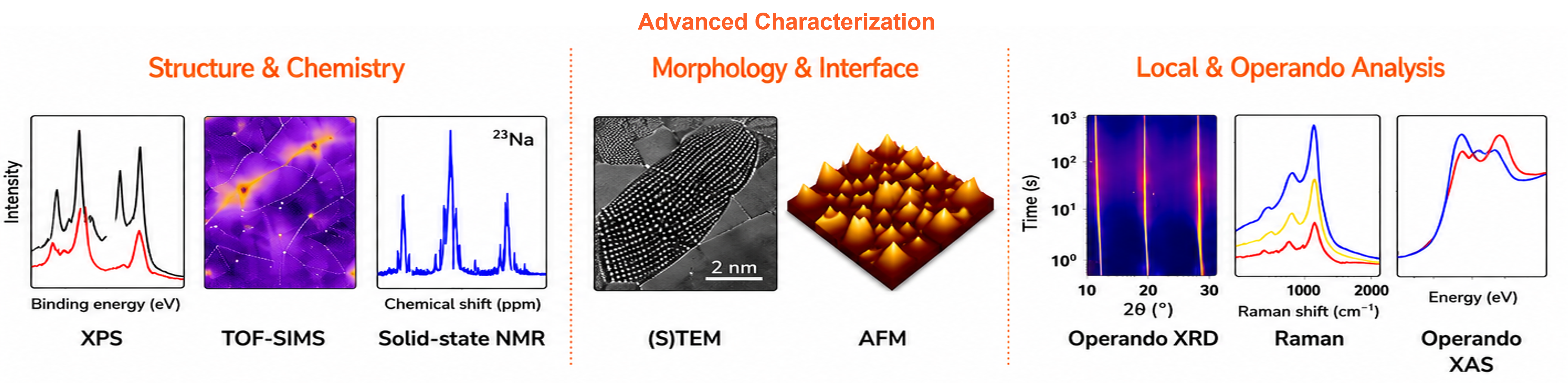
| Advanced characterization is essential for revealing the structure–chemistry–property relationships that govern battery performance, degradation, and safety. We intensively use synchrotron-based X-ray and in-situ/operando synchrotron techniques to track phase evolution, local coordination changes, interfacial chemistry and reactions, and dendrite formation under realistic battery operating conditions. These measurements are complemented by XPS, TOF-SIMS, solid-state NMR, electron microscopy, AFM, Raman spectroscopy, etc., to provide multiscale insights into composition, morphology, interfaces, and reaction pathways. Together, these tools establish a mechanistic understanding that guides rational electrolyte design, interface engineering, and device optimization for high-performance batteries. |
|
Representative work:
- Y. Wang, B. Jose, Y. Yuan, A. Ganesh, R. Faisal, K. Chan, J. Bekou, L. Liu, P. Kaghazchi*, Y. Zhao*, Revealing the Neglected Role of Passivation Layers of Current Collectors for Solid-state Anode-free Batteries, Advanced Materials, 2025, 37, e13090
|
-
Liquid and Solid-state Battery Recycling
|
|
|
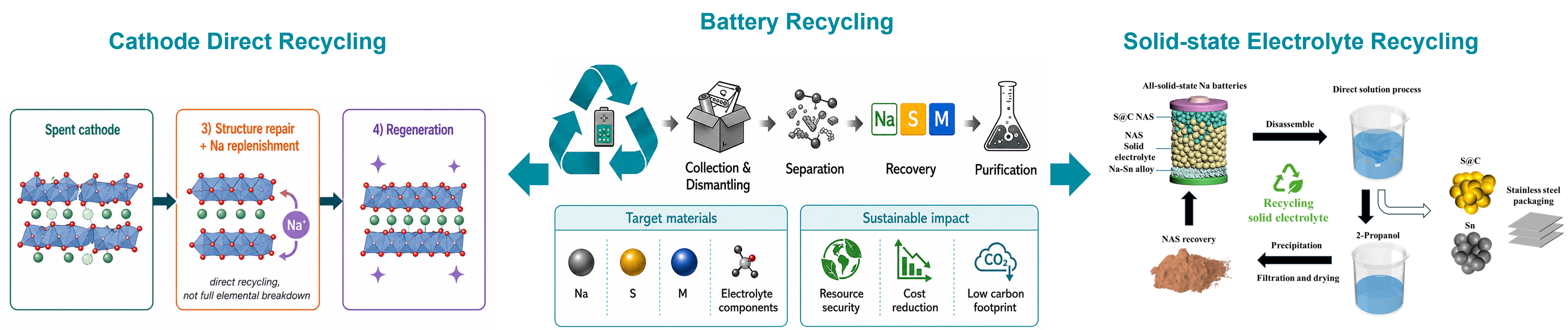
Battery recycling is increasingly important as the rapid growth of electric vehicles and grid-scale energy storage creates rising demand for critical materials, lower-cost manufacturing, and environmentally responsible end-of-life battery management. Our work on battery recycling focuses on developing sustainable strategies for both solid-state battery components and conventional cathode materials. For solid-state batteries, we emphasize recycling and regeneration of solid-state electrolytes. In parallel, we develop direct recycling approaches for different cathode chemistries, including LCO, NMC, and LFP, aiming to repair crystal structures, replenish lost lithium, restore electrochemical activity, and retain the value of the original cathode framework without complete elemental breakdown.
|
Representative work:
- Y. Xu, R. D'Souza, E. Jin, Y. Yang, V. Martins, Y. Wang, Y. Gan, M. Yang, R. Zhang, X. Pang, X. Ma, Q. Tu*, Y. Zhao*, Closed-loop Recycling of Sulfide Solid Electrolytes from Spent Solid-state Sodium Batteries, Advanced Materials, 2026, e73359
|